Monday, April 07, 2008

8 little known things about Falkayn

Anthony tagged me with this old meme. Here are the 'rules':

  1. Each player starts with eight random facts/habits about themselves.
  2. People who are tagged need to write a post on their own blog (about their eight things) and post these rules.
  3. At the end of your blog, you need to choose eight people to get tagged and list their names.
  4. Don’t forget to leave them a comment telling them they’re tagged, and to read your blog.

So here are 8 little known things about me:

  1. World traveller
    My Dad's work always took him around the world. That led to my family living in New Zealand, the USA, Canada, the UK and back home in Australia. By the time I was 10 years old I had travelled around the world roughly 5 times (and I've done it another 4 times since then).

  2. Sailor
    In 1986 I did the Sydney to Hobart yacht race. As one of the few Category One ocean races in the world it was a challenge, especially as I was just a teenager. I sailed with my Dad on his boat Dreamtime, and he made sure I trained properly. So it was a half mile swim every morning before school that year, a training sail midweek and then weekend ocean races, with me completing the mandatory two overnight races in the lead up to Boxing Day.

    It was a tumultuous 4 days with gale force winds, rough seas, a crew that was only half experienced and cold, wet conditions. As my Dad had intended it was a watershed moment for me - I ran the mainsheet and at one stage we were in a death roll whilst skimming down the Tasmanian coastline, and I had to ignore panicked commands from my fellow crew (men in their 40s!) and just listen to what my skipper (Dad) was telling me to do.

    I survived that race (and the return sail), but it was quite a few more years before I could be convinced to start ocean racing again. However, I helped my Dad move his new boat, One Step Ahead, from Pittwater to Sydney Harbour a few weekends ago, and you know what? It felt pretty good being out on the water again, and it's not many guys who can say they've "sailed with my father, man and boy, these twenty years".

  3. Bent middle fingers
    The last joint on each of my middle fingers is bent outwards slightly. It's something to do with the angle of the joint because they seem to straighten up when they bend. Weird, huh?

  4. Hate sandals
    Sorry but closed shoes are what I prefer - even on hot days. Having said that, living closer to the beach has caused me to actually buy a pair of thongs.

  5. Love to cook
    It seems to be something about the physicality of cooking, along with the appreciation for good results, that makes me love cooking. I'm not a fast cook, but there is nothing more relaxing after a hard day's work than taking an hour or two to turn out a nice meal. Of course you sometimes have to knock up something edible out of minimal ingredients with 20 minutes notice - that's definitely less fun.

  6. Chlorine blind 
    One family holiday in Spain when I was very young my Dad tried to help me learn to swim with my eyes open underwater. It was a pretty successful day, with me triumphantly announcing I could now swim underwater. However I woke up the next morning unable to open my eyes due to an allergic reaction to the (massive) amounts of chlorine the hotel had dumped in their pool. I've been a firm believer in swimming goggles ever since!

  7. Skiing a white Christmas 
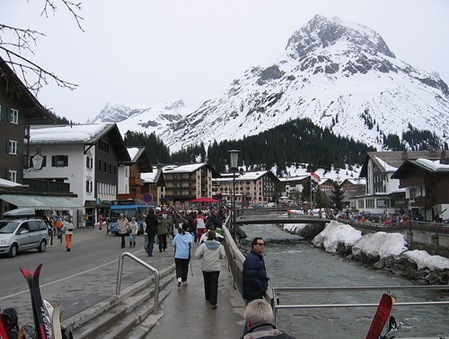
    I spent the bulk of my childhood living in the UK, and one of the (few) nice side-effects of that was my family being able to take holidays in Europe very affordably. The best ever holidays turned out to be ones we had around Christmas when my Dad took us to Lech, Austria for skiing trips (it wasn't quite so exclusive then). We would go for two weeks at a time, and spend the first week re-acquainting ourselves with the sport and the second week revelling in the fantastic snowfields of the region.
    100259289_458867cb28 
    My fondest memory is of getting woken up just before midnight on Christmas Eve to gather at the local church, sing Carols and watch the midnight torch run, local ski instructors snaking down the mountain in lines, carrying burning torches to light up the dark. There's something spectacularly appropriate about all that fatty Christmas food that suits cold, snowy places - somehow 35 degree Centigrade sweaty Christmas days in Oz better suit cold seafood and salads.

  8. Swordsmithing
    Back in my university days I hung out with a bunch of friends who were all into roleplaying games, and hence swords, armour and pretty much all sorts of historical military goodies. We were also into martial arts, especially Japanese ones (I did Judo). One of the guys had a book on Japanese swordsmithing, which we pored over. I had topped my year at school when it came to Design & Technology, and I fondly remembered standing over the forge bashing out some metal.

    I remember dreaming what I would like to do in the future and imagining the perfect blend of natural environment, zen-simple lifestyle and heady success. For me that seemed to be an Austrian chalet on a mountain in New Zealand, with a fully kitted out forge in the back and international customers waiting for one of my original katanas ... since then I've had a friend actually take up blacksmithing, specialising in historical reproductions of weapons (spears, swords, etc). As is often the case the reality turned out to be far more prosaic and boring than you imagine.

So there's 8 (reasonably) useless facts about me. In the spirit of this whole meme I'm going to tag eight other bloggers to follow on:

Monday, March 31, 2008

Great new laptop, but woes with Vista

dell-xps-m1330Life seems full of swings and roundabouts, or if you like, ups and downs. So I have been getting used to my shiny new Dell XPS M1330 laptop and enjoying the unbridled pleasure of being able to work when mobile. But at the same time I have been discovering how little Vista loves developers, or at least the software tools I'm using to develop in.

The problems I've had have been numerous, but I'll restrict myself to describing the ones I've got an answer for.

  • VS2008: Must run as admin
  • Indexing Service is now legacy code and not installed (by default)
  • IIS6 metabase and configuration compatibility (see here for more info)
  • Watir needs windows-pr (gem install windows-pr)
  • Watir conflicts with Office 2007 Groove
  • IIS7 suffers from the same 'usability facelift' woes as does Office 2007
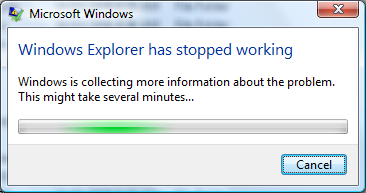
  • Explorer keeps crashing ... actually I don't have an answer for this one

In addition I set the ruby.exe and rubyw.exe files to run as admin and did the same for Aptana Studio and java.exe. That was on the way to finding out that the Groove DLLs had some sort of conflict with Watir/Ruby. I also set nearly everything to run in Windows XP SP2 compatibility mode and disabled UAC along the way.

As usual, once you have everything up and running you forget about your setup woes, however the near constant Explorer crashes are getting on my nerves. It's especially frustrating when you have 2 or 3 Explorer windows open to various important directories (some on other machines) and then have Explorer crash because you opened Control Panel ...

explorer-crash 

UPDATED: Added link for IIS metabase issue.

Tuesday, March 18, 2008

They're just making it up ...

In Sydney for Sun's TechDays James Gosling (his blog), creator of Emacs and Java (you might have heard of it), has a chat with the SMH:
“People you think are oracles of wisdom - they're just making it up.”
Preach it bro' ...

Monday, March 10, 2008

It's the software that matters!

James Shore, creator of NUnitASP and author of The Art of Agile Development has recently announced that he's no longer supporting NUnitASP development, citing his increasing lack of interest in it and pointing interested parties to Selenium or Watir (or perhaps WatiN, although that has received some criticism from Scott Bellware, others are not so sure).

It's a shame we're not getting more choices in this area of testing, but James is right to focus on his own current projects. He has left it open for someone else to take over the project, although the way ASP.NET MVC will expose HTTPRequest as an interface might make it superfluous.

Back to the point of this post. James has a great blog with some very thoughtful articles. I found this great quote in It's the Software, Stupid! It summarises for me the problem with simply implementing Scrum and thinking that makes you Agile.
“your team is expected to self-organize and define its own practices”
“It's time we brought back the early emphasis on great engineering practices. If you're using Scrum or another agile method that doesn't include engineering practices, realize that your method is incomplete. Scrum, for example, intentionally creates an environment in which your team is expected to self-organize and define its own practices. If you aren't doing that--if you aren't talking about engineering practices, what's working, what's not, and how to improve--you're going to run into trouble someday. Probably someday soon.”

Thursday, March 06, 2008

Are VB's XML Literals an XSLT killer?

The VB Team have released the first in a series of XML Cookbook recipes. This one covers how you can use VB's new XML literal support in Visual Studio 2008 to replace the W3C's rather cumbersome XSLT (eXtensible Stylesheet Language Transformations) language with much simpler VB code.
“To sum things up, we’ve seen how Visual Basic, XML Literals and LINQ can be used in place of the <xsl:copy-of>, <xsl:for-each>, <xsl:template>, <xsl:if>, <xsl:value-of>, and <xsl:attribute> elements as well as using XML Axis Properties in place of XPath to create a powerful, yet simple tool for XML transformations.”
As someone who once developed a web site completely using Java servlets spitting out XML data using XSLT files to transform that into web pages, I've got to say that anything that gets us away from XSLT is a good thing. The way you can use LINQ to query the XML data is inspired, and this has the potential to make VB the language of choice for developers needing to glue together SOA.

Monday, February 25, 2008

VB come backs to scripting

Paul Vick, the Principal Architect for VB, gave an interesting talk at the Lang.NET Symposium about the future direction of VB with regards to scripting. He also discussed this on his blog:
“The main theme of the presentation is the same one I've been talking about on and off over the past year or two: moving Visual Basic back towards it's scripting roots. The main thrust of this presentation was the technical side of the story--namely, what we would need to do to the existing Visual Basic compiler to be able to effectively use it as a scripting engine. The presentation talks some about the way the compiler is structured, how it might change and some of the things were thinking about enabling.
“all the services that the compiler provides...are available to be used by any program that needs them.”
In particular, what we'd like to see is not just that Visual Basic can be embedded anywhere, but that all the services that the compiler provides--parsing, semantic analysis, code generation--are available to be used by any program that needs them. The DLR is a key part of this, but there's a lot of work on top of that.”
He also pointed out that language changes (like the XML native stuff in VB9) are necessary too:
“One thing this presentation didn't cover (and which Ted Neward brought up in the Q&A afterward) is what we might do to the language itself to make it more scripting-friendly. That's an area where things are less well-defined and even more speculative than what I talked about, so I left it out for now.”
Making the IDE services available to other programs allows a suite of competitors to Visual Studio to open up - so I'm not sure whether that will really fly (unless it's protected by licensing). But it does offer intriguing possibilities for scripting tools for administrators to use (provided they are familiar with VB) and perhaps even the ability to give end-users some access to create code in a Domain Specific Language (DSL) that makes sense to them. It could let you create an online query tool for large XML files. Whether modern systems administrators will welcome this sort functionality is another thing of course - and the security implications could be pretty scary.

Monday, February 18, 2008

Feeling secure or not ...

ZDNet.com.au have posted an interesting short interview with Bruce Schneier, security guru and author of Applied Cryptography and Beyond Fear.

They point out that he highlights that there is usually a difference, sometimes a great one, between how secure we feel, and how secure we really are. I've added to the quote below a bit missing in the ZDNet article (highlighted):
“When something rare happens it's talked about endlessly. It's repeated again and again so our brains are fooled in to thinking it's or common because it's what psychologists call "available" -- the memories are more available. And one of our mental short cuts is to think of things that are more available as more common. So we might not phrase it that way, but we react as though terrorism or child kidnapping is more common than it really is, because the media endlessly repeats the rare thing.”
I was discussing with some other parents this very issue the other day. We are all hyper-aware as parents of the potential for our children being snatched from us at the park or shops, and so we find ourselves placing boundaries for our children that we never had ourselves.

For example I remember as a 5 year old I was allowed to run around the local neighbourhood (we lived in a cul-de-sac) and playing in the banks of snow that snowploughs had pushed up on either side of the road (I lived in Toronto, Canada at the time). There is NO WAY I would allow my kids to do this now - for one thing a minor car accident could have resulted in a car plunging into our snow bank, and clobbering us in the process - I'm too aware of similar improbable events occurring. For example a local pre-school was recently hit by an out of control driver and several children were badly hurt.

However my parents weren't being bombarded with stories about that sort of thing, so they thought it reasonably safe letting me play on my own outside (although there was the time I got busted throwing overripe oranges at passing cars ... and one driver had his window open).

In reality the chances of my being wiped out by an out of control car were probably no greater in that snow bank than they were while crossing the road, or being driven to school in the family car (possibly greater as my Mum grew up in sunny Australia, and never much liked driving on icy roads).

The problem is that we make decisions based on emotions rather than pure logic, and that is no matter how coldly logical we try to be. 'Fear' is an emotional warning sign that lets us know when something bad could happen, but as Schneier points out it is biased towards events that we 'know' about, thus giving media stories an unwarranted weight in our decision making.

Schneier wants us all to talk different about real and felt (security) risks as he feels that the ambiguity of English (and many other languages) means that we help the process along:
“In effect we have two very different concepts mapped on the same word. And this makes a lot of conversations about the feeling and reality of security hard to have because our language fails us.”
In IT terms the problem is not so much the software as the hardware - we could remove the obfuscation by ensuring we always qualify our statements with a disclaimer as to whether we are talking about 'feeling' secure or 'being' secure. Our brains are built to respond to emotional triggers, when someone tells us something is true we use emotional cues (theirs and ours) to help us evaluate if that is really true.

[UPDATE: Fixed minor typo.]