Showing posts with label Australia. Show all posts

Wednesday, October 22, 2014

Evaporating Web Records

You’re hip, you’re cool – ‘business enablement’ is your middle name, and you’ve got social media accounts, blogs, forums, Atom/RSS feeds and wikis rocking and rolling. As Chief Records Officer (CRO) you help your agency move into the 21st Century full speed ahead.

Except. Things are never that easy, and what we find is web records are sadly missing.

We know that a short URL was used in this tweet, but 2 years later the URL has been re-used and no longer points where it did when we created the tweet. Worse yet, we relied on identifying records at creation and we missed one, it never got recorded and Facebook’s API is refusing to give it to us.

The wiki system was migrated to a new platform and the old edit history has been lost – worse the new system tracks comments in a different form and they have been lost too.

An ill-considered rollout of a new website neglected to ensure that all of our old URLs were migrated, and apart from losing Google ranking, we also now can’t identify what content a user might have seen on a given date for a given URL.

In other words, our web records are evaporating. It’s not your EDRMS that’s failing, it’s the fact that all of these web systems exist outside the EDRMS and compliance needs are seen as a secondary (unimportant?) requirement for replacement systems. Practical needs for delivering services now are overwhelming the old centralised compliance needs.

The “Review of Social Media and Defence” report in 2011 by George Patterson Y&R is a good example of the sorts of problems agencies face:

“Given the dynamic nature of social media communications and the collaborative approach to the creation of user generated content, Defence will need to take particular care to ensure that such content is properly identified as a Commonwealth record as and when it is created. An accurate and authentic copy of such content will need to be captured and saved as a record so as to ensure that obligations under the relevant auditing, recordkeeping and disclosure legislation can be met. This is likely to require the development of a specific Defence social media records policy that provides guidance for each particular social media channel to be used by Defence during Professional Use.”
Review of Social Media and Defence, p.102

“The simplest interpretation of international record-keeping policy is that all outgoing communication should be housed on an official website that provides both a credible source for the community and a method of archiving content. The content can then be shared easily into social media, and important or significant conversations can be selected for archiving.”
Review of Social Media and Defence, p.124

“Because the National Archives of Australia (NAA) considers social media to simply be channels in which Commonwealth records can be shared, existing record management and archiving protocols need to be followed. The challenge lies in identifying commonwealth records worthy of archiving but also in the resourcing and processes required to ensure compliance. The government’s response to the Government 2.0 Taskforce (p. 15) states explicitly that the Archives will produce guidance on what constitutes a Commonwealth record in the context of social media. The NAA should be consulted to provide greater clarification for DEOC.”
Review of Social Media and Defence, p.157

Rebecca Stoks produced an academic paper in October 2012 that summarised a survey of actual recordkeeping practices for social media records amongst Australian government agencies (mostly state (33), but some local (20) and federal(9) agencies). Her summary was damning:

“The transient nature of social media opposes traditional recordkeeping methods; consequently, most government agencies are not meeting their legal obligation to keep records.”
Taming the Wild West: Capturing Public Records Created on Social Media Websites, p.8

“In this study, only a minority of government agencies were found to be capturing social media records. Most of those capturing records were not very confident that they are meeting their legal obligations or that their methods are sustainable. Within the sample, the level of internal support, be it strong or lacking, was found to affect the degree to which social media records were being captured. Although well regarded as a resource, the guidance provided by PROs did not seem to have an impact on whether or how agencies were capturing records, with several respondents expressing a desire for more practical advice.”
Taming the Wild West: Capturing Public Records Created on Social Media Websites, p.48

What do we want to know about web records when we capture them?

  • URL
  • AGLS meta-data (author, publish date/time, country, copyright, etc)
  • Re-use (trackbacks, retweets, inbound links, ratings, likes, votes)
  • Outbound links, and their status (if they redirect, then to what URL? do they have meta-tags set like NoFollow?)
  • Linked resources (images, JavaScript, iframes, Flash files, video/audio) – not always useful, but worth bringing images into content as an embedded image at very least
  • Conversations started by the record (comments, replies, threads in general)
  • Relative site-map location compared to other web records (requires the concept of a site, perhaps leverage Google site maps?)

Much of this comes from Atom/RSS feeds, but some of it requires post-capture processing.

How do we want to see web records that we capture?

  • As an HTML page, even though stored as XML.
  • As a PDF, even though originally seen as an HTML page and stored as XML.

Of course this only gets us 80% of what we need, there will always be the missing context of what the page design looked like when that content was displayed (and what other content was dynamically displayed alongside it). With social media there is also the context of an responses, retweets, likes, shares or trackbacks to consider.

Do we organise web records by the site they belong to, the Atom/RSS feed they come from, or by some other more definite measure?

I don’t know anyone that has all the answers to those questions, I’m not even sure I know that many people that care about all those questions! However, I do know that without those answers there are essential government records that are literally evaporating every minute of the day, never to be seen again, or known about. They may not be important now, they may not ever be important, but our lack of care with them is likely to be lamented by future generations seeking to understand what motivated, inspired and drove us into action (or not).

Friday, May 18, 2012

AusCloud Forum May 2012

I had the pleasure this week of being OrionVM’s guest on the panel for this month’s AusCloud Forum (see tweets).

The panel I was on followed the three keynote speakers:
  1. David Yuile, CEO of AAPT on Powering the Cloud
  2. David Werdiger, CEO of Billing Brureau on SmartBilling
  3. Sheng Yeo, CEO of OrionVM on Carrier Clouds
The speakers were interesting in the most part, I think David had us the most entertained, but unfortunately he was in the dark for most of it (and really needs to read Beyond Bulletpoints as his first slide had tiny icons I couldn’t even read from the 5th row.
The panel was about “Enterprise in the Cloud” and put me in some very flattering company:
We had several great questions to answer, and some interesting variances in opinion. I wasn’t tracking well enough to keep everything in order, but some of the high points from my point of view were:

Cloud Has Arrived

It is clear that enterprises are switching to use the cloud, at least on new/internal projects. This was backed up at yesterday’s AWS Summit where News Ltd and Realestate.com.au both shared they have moved their development/test environments over to Amazon’s cloud. This is what we’re doing at Elcom. Our release testing now occurs on servers at OrionVM that get spinned up when we need them and archived  in between.

Hardware Must Be Sweated

Both Roger Lawrence and David Yuile were emphatic that enterprises have significant hardware (and skill) investments that need to be sweated before they will feel free to move to the cloud. Sometimes these can be re-tasked for other duties, but all too often they can’t be (few banks are moving their mainframe code just yet (although MicroFocus and Heirloom Computing both offer COBOL in the cloud).

Give Me Standards

David Yuile was heavy on the need for cloud standards, and he thinks that larger players should put some money up to ensure standards get worked on properly. He likened the current trepidation about cloud to the same feelings enterprises had about VLAN – and in a similar fashion he thinks some standards will help it go mainstream.
Roger pointed out that there’s a difference between standards and certifications, with the later being what most enterprises care about. I agree to a point, as a small ISV we can’t always afford to get all the certifications we’d like to, and being able to assure customers we can adhere to a standard is often all we need to do.

CIOs See New Savings, CEOs See New Possibilities

Roger had a very interesting point to make about how different occupants of the C-suite tend to approach cloud. CIOs tend to see the cost savings and efficiencies to be gained, whilst CEOs come from the point of view of what new possibilities the cloud offers their business. A case in point was that of a large construction company where IT costs were around 1% of revenue – any saving being negligible – but being able to reduce the wait between delivery of goods to clients and payment of invoices from 27 to 26 days was worth $34M in extra cashflow.

We Ain’t Seen Nothing Yet

I think we have barely seen what the real effect of the cloud will be in the enterprise arena. Most technology shifts are not really embraced until the generation that grows up with it gets the chance to flex their muscles in the workforce and for the cloud that is still 5 years or so away. When you have grown up with streaming media as the norm, mobile access the primary means of internet access, true ubiquitous computing and commoditised cloud services how differently will you regard the problems enterprises (and countries) face today?

Cloud Helps Startups, But Not That Much

There is some lurking optimism that if we just commoditise the cloud and computing enough then startups will suddenly multiply and change the world. Unfortunately for that rather utopian idea the lowering of the barriers to entry helps everyone, big enterprise innovator and  garage startup alike – it also means more competition and noise to rise above.
An example comes from my wife’s cousin who has worked in the Australia games industry for over 15 years. The industry is currently deep in recession, but it looks like it’s healthy because so many developers are trying their hands at mobile games. The problem is that few (if any) of them are making any money (Halfbrick being a notable exception).

Microsoft’s Future (bonus)

Not particularly cloud related, but a subject dear to Roger and my heart and something that came out of one of the questions asked. We both have strong opinions on this, but what it boiled down to was the success of Windows 8 will define how much affect Microsoft has on the future.
Roger pointed out that Microsoft might lose it’s way, but like IBM, still remain a giant in the IT space. He also noted that Microsoft’s partners, as heavily invested as they are in its success, are a mighty (not so) secret weapon when it comes to their success in the business world.
Personally I think their Windows 8 Metro UI is inspired, and will probably be a great hit on tablets and mobile devices … it’s penetration into the business world will be limited by old non-touch LCD monitors (see “Hardware Must Be Sweated” above). However, Microsoft will both find ways to maximise the switch, and will care less than it used to if it can wrest majority control of the mobile/tablet space from Apple/Android.

Thursday, March 10, 2011

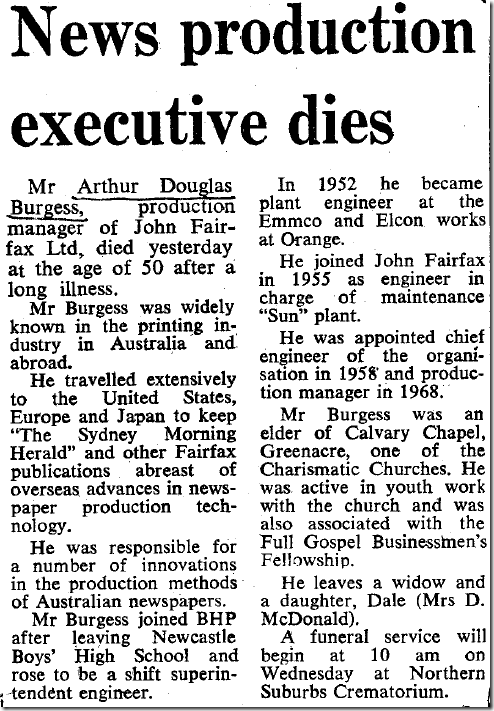
Arthur Douglas Burgess

I just got delivered a very nice present. The National Library of Australia maintains an online archive of Australian newspapers for the last hundred years or so called Trove (http://trove.nla.gov.au/). A couple of weeks go I found a reference to my grandfather on my mother’s side, and a few days ago I ordered a copy of it via PDF. Thanks to the miracles of scanning + the internet, here it is:

Arthur Douglas Burgess Biography

My other grandfather was also involved with Fairfax and the Sydney Morning Herald, but in the capacity of a typesetter on the printing presses.

Thursday, March 04, 2010

Sydney Scrum Meetup (March)

Jeff Sutherland and Jens Østergaard visited the Sydney Scrum Meetup last Thursday. We had some great pizza and then they got everyone doing the Nokia test!

My Test Results

Iteration length, 2 weeks – 10

Testing, customer acceptance testing – 8

Agile specifications, poor user stories – 4 (good enabling specifications might be 3-5 pages long – before sprint planning)

(for venture companies Jeff finds that 2 sprints planned is necessary)

Product owner, product owner with backlog – 5 (or 2 with last project!)

Product backlog, single product backlog - 3

Estimates, backlog estimated by BA – 0

(Jeff said that usually as teams get better their stories get smaller and eventually are about the size of tasks, and then estimating changes to use points vs hours – surprising what can be untangled and done separately)

Sprint burndown chart, no chart, but team knows velocity – 0 + 3 + 2

(Jeff mentioned that partial completion of tasks creates a high-risk environment)

Team disruption, project leaders telling people what to do – 3

(self-organise to maximise velocity)

Team, no emergent leadership - 1

Total = 4.33

Most of the room were between 2 and 5, and apparently, most of OpenView’s venture companies start out around 4, but when they work on it they end up around 6. It looks like TIDC might have a great Scrum team as someone from there scored 8 for their team! (they were the only one higher than 5)

If your reference stories change then so do the story points. But Jeff said it is really the delta in velocity that is interesting. One of the symptoms of hyper-productive teams is that you get asked to slow down!

  • Sustainable pace
  • Quality
  • Velocity
  • “Balanced Scorecard” (not right term, but Jeff couldn’t remember what it was)

Jens recommends the XP game for teams to learn about velocity.

How long does it take to fix a bug from CI/automated testing. If longer than 2 hours then create an impediment list and get the Scrum master to remove them. Simple metric, track the day you start a story and the day you finish a story and then compare to your standard process efficiency (usually around 20% – measures the quality of your backlog) {calc elapsed days versus theoretical ideal days based on velocity}. Raising the efficiency meant getting the backlog well enough detailed that you spend less time waiting to do a particular item. Measuring the time to Done.

Speed of testing is usually the bottleneck, and is more important than the speed of coding. So interrupt devs immediately with a bug, rather than leaving them to finish what they’re doing. The availability of testable code is another way of thinking of it.

Just evaluate the code in production is one way of incentivising people.

I asked about how to handle client projects using Scrum, Jeff mentioned that Systematic is doing big fixed price contracts using Scrum. They provide 2 bids on every project, with the Scrum bid at around half the price.

In response to someone’s question about Scrum, Jeff mentioned he’d written about the answer in an article titled Future of Scrum from the Agile 2005 conference.

Metrics to Live By

Jeff got me hooked on metrics as it is obvious when talking to him that empirical process control requires metrics to be successful. Some of these metrics assume that you use story points for estimating, which we have done with some success on one project. To do this well you need a range of reference stories of various sizes and rough sizing (e.g. Fibonacci numbers) that the team can agree on the size of.

Here are some of the metrics Jeff mentioned:

Backlog Velocity = story points/sprint

Sprint Velocity = story points ‘done’/day

Efficiency = story’s ideal days/actual elapsed days from ‘start’ to ‘done’
(if an item should have taken 2 ideal days, but it actually took 10 days from the ‘start’ to the ‘done’ date, then you have 20% efficiency)

Churn = % of ‘done’ items that testers send back to developers for fixing
(if all items churns once then you have 100% churn, if half of those churn again then you have 150% churn! Ignore size of item when calculating)

Jeff has an upcoming conference session on this very topic and he discusses it further in his Excel Spreadsheet for Hyperproductive Scrum Teams post. The spreadsheet seems a little hard to get into, but I’ve given it to our Solutions team to review.

Friday, May 29, 2009

Half of TEDx Sydney 2009

Thanks to Josh Anstey's generosity I was able to attend TEDx Sydney last night. Whilst it was enjoyable, I ended up leaving at the half-time break and spending the evening with my family instead. Nevertheless if you're interested in TED then I would recommend giving an event like this a go, if nothing else there were some great people there like Mark Cohen, Jodie Miner and Brian Maguire.

Some background: TED is an event that focuses on thought leadership in the Technology, Entertainment and Design fields every year and has as its catch-cry "Ideas worth spreading". The TED conference sells out quickly every year (despite some unusual conditions) and attracts all sorts of luminaries and leaders. A TED event is the place to meet movers and shakers and has been the birthplace of some wonderful ideas over the years. They make the videos of each event available online during the year, and part of the focus of a TEDx event is to create that same buzz in a local venue by mixing TED videos with local speakers.

So without further ado here is my thoughts on TEDx Sydney 2009:

Venue

The Australian Technology Park hosted the event, and as that is where Elcom is based that proved convenient for me. The theatre used was a great venue for watching TED videos and live speakers alike and I think it did a good job of providing some atmosphere - although I wonder whether other venues could have made a bigger impression? (e.g. Darling Harbour Convention Centre)

MC/Host (Nils Vesk)

I don't think a Gen-Y host was the right choice for an event like this - I think less entertainment and more credibility was needed (although it was Mark Cohen who blew Nils' credibility for me). However, Nils got the job done, and managed to do the more cheesy sales aspects of his role without making it seem too cheesy (more about that later).

Craig Rispin (Futurist)

I have heard of Craig Rispin, and indeed knew someone who he'd invited to the event. Unfortunately his recursive telling of the history of futurists who tell the history of the future left me bored and dual-tweeting with Mark Cohen.

I'm not sure Craig had an idea worth spreading, perhaps he intended it to be that we are all futurists, but it felt more like he was telling us that we were smart and forward-thinking people - which was nice of him, but didn't give me a reason to care about his talk. He also pointed out the prophetic nature of speculative/science-fiction in a way that might have impacted those who didn't yet care about it - but I've known about that for most of my life so it was wasted on me.

Patti Maes (Video, MIT Media Lab)

Patti Maes is from the MIT Media Lab and demonstrated a form of augmented reality where her students had cobbled together a wearable apparatus that linked a camera, phone and some software so that you could make any surface around you into a computer work area, and interact with your environment in ways that could both instruct the computer/camera to do something (e.g. take a photo by holding your hands up in a rectangle) or could bring digital information to you based on your context (e.g. talking to a person, reading a book, looking at a product label).

She pointed out that the technology could be cobbled together for a few hundred dollars easily enough, but their point was that they were investigating what were reasonable ways to augment reality. Some of this has been done before with for example the head-up displays (HUD) that Boeing engineers use when wiring plane bodies.

This was the most exciting talk, but hardly surprising to anyone who has been following technology for the last 15 years or so.

Peter Baines (Hands Across the Water)

Peter Baines was one of the forensic specialists sent to Thailand in the aftermath of the recent Boxing Day Tsunami. He gave us a fairly somber account of that, especially dealing with the human side when giving bodies back to relatives. He went on to show how this created a desire in him and his colleagues to do more than they were for the Thais - out of that desire was birthed Hands Across the Water.

I think that Peter's idea worth spreading was that if you just focus on the results, and not the obstacles, then you can achieve your dreams - whatever they are, whoever you are. I think this was a great message, and Peter is obviously a good example of this in action. Focus, and the single-minded pursuit of an idea, is too often given lip-service as a reason for success, when I believe it might just be the major factor in it.

A large part of Peter's story was a dig at the international aid agencies that quickly went into Thailand and then just as quickly pulled out around a year later. One of his ideas is that charities should be forced to put some stats on every piece of marketing literature telling the reader how much money they spent on admin versus aid in the last financial year. The idea (much like the MIT Media guys) being to give people information to make informed decisions about where to give their money. I think this ignores part of the bigger picture, which is a question of how much admin is required to run an international charity that coordinates volunteers from many nations into situations that are often not as attractively packaged as the Thai one was. However that discussion can't happen without making the information available, and so I would welcome it form that point of view.

Bill Gates (Video, Curing Malaria and Making Teachers Better)

I had seen this one before, but hung around to watch it on the big screen. Bill and Melinda Gates' foundation is really trying to focus money and attention onto big issues that the market and governments are ignoring.

The first issue he covered was curing malaria, which seems both an achievable aim and one that has been largely ignored now that wealthy nations are free of it. His idea here was that if we focus on eradicating it then a relatively modest effort will see it gone, whilst if we tackle it half-heartedly we only make things worse.

The second issue was about how do you make teachers great, and he gave a long analysis of why this mattered, which seemed obvious, but I guess the hard numbers he pulled out showed people that it was an issue worth focusing on. I think his idea here was that we should care about the quality of teaching - mainly because in the US at least, the quality of a teacher is not easily discovered or rewarded.

Event

Overall the event had a good vibe, seemed interesting, and was a good way to share the watching of a TED video with people you knew. I think I missed too much of the schmoozing part of it to know whether that worked - but I was happy catching up with who I did see there.

There was a cheesy side to the event which was the blatant pushing of wares for the main sponsors, especially the silent auction of the Thought Leaders' services (with some fairly suspicious dollar figures on their market value). I understand that some of this is necessary to get the event paid for - but I do wonder if this could have been handled in a more subtle and positive way.

Wednesday, October 29, 2008

ALT.NET Sydney - NHibernate and ASP.NET MVC

(Microsoft are definitely capitalists, just look at all the caps in that title!)

I went to the second ALT.NET Sydney meeting last night and really enjoyed myself. Richard Banks from ThoughtWorks is organising the event and pizzas, saucy chicken wings, beer and caffeinated beverages were kindly provided by ThoughtWorks (which looked like it had plenty of people working back).

After Richard hit off with the news and we ate/drank we had a joint presentation by Damian McLennan (NHibernate) and Ali Shafai (ASP.NET MVC). I think the point was to show each separately and then point out how easy NHibernate made the back-end in ASP.NET MVC - but we distracted Ali and had a more interesting general discussion about MVC.

I probably got more out of the NHibernate session as that was the piece I was least familiar with. We had a few people in the audience who have "been there, done that" which was great because it gave us some very interesting discussions.

See Richard's summary post on the group blog, or Damian's NHibernate post for more links.

Friday, August 01, 2008

Wednesday, July 23, 2008

Oz attempt at Kiwi humour, eh?

At the risk of offending my Kiwi (i.e. New Zealand) friends, here is a great ad that channel 7 presented after the Wallabies vs Springboks rugby game:

Even knowing it was a stunt ad, it still put the old fire in the belly that Bledisloe Cup matches need.

Friday, July 18, 2008

It's the water

There is something elementally satisfying about my current commute, and this morning I realised what it is. It isn't the beautiful houses (Mosman) or views (Spit Bridge/Harbour Bridge) we go past; it isn't the crowded buses or traffic jams either. It's the water.

No, I'm not guzzling some funky, intelligent, over-hyped, green-hating plastic bottled über-water, but rather looking out over the harbour, Sydney's great appendix of the Pacific Ocean.

taken by goosmurf

It's not the beaches that move me. Nor am I fascinated by the breaking waves. In fact that is just the sloppy, noisome edge of the real deal ... the Sea - mistress of ship Captains and mighty in her play and rage alike.

Playing in the surf is fun (I thoroughly recommend it) but it's rather like running to work - a more primitive existence, where we rely upon our body's strength to sustain us - and frankly as the world's ultimate tool makers it behoves us to take a more mature approach to something as dangerous and amazing as the Sea.

Like many things in life, it's my Dad's fault. As an aside I'm sure my son will have many things to lay at my feet too ... if you're just getting to grips with your own parents' imperfections then I suggest you look at something like the Search for Life course from Careforce Lifekeys.

But I digress. The reason it's my Dad's fault is that he exposed me at an impressionable age to the Sea via his yacht Dreamtime. I was around 13 when I first held the wheel of a large boat (41'6") and it was thrilling. In the rest of my teens I spent many a weekend racing with my Dad and his crew and thoroughly enjoyed most of it (except for the end of the day when we cleaned up).

I find that the Sea is the place where I feel most spiritual and closest to appreciating the sheer grandeur of my heavenly father's creation (I was going to say handiwork, but he spoke it into being ... hey! Maybe Bill Gates is right about the future of speech recognition after all?).

Thursday, July 10, 2008

bCisive gets the Minto Pyramid Principles

One of my favourite Australian software tools is bCisive by Melbourne company Austhink, led by Dr Tim Van Gelder.

They have recently announced that they have “entered into a Memorandum of Understanding to collaboratively produce a Minto software product based on the Minto Pyramid Principle® and Austhink’s bCisive product”. This is great news as it joins the easiest argument mapping tool (I know, I've tried lots of them, including Standpedia, which looks like it died at the end of 2007) with one of the pioneers of informal argument mapping in the business world.

I first came across Barbara Minto years ago when my Dad loaned me her Pyramid Principle book. I lost that first copy, but replaced it and got my own as well. It really should be mandatory reading for anyone who ever has to write a proposal or training document.

Below is a screenshot of a product strategy bMap (bCisive argument map) I prepared for our TrainingManager.NET product:

Product Strategy bMap

The user interface does a great job of getting out of your way, but being accessible when you need it. The two orange buttons at the bottom of the window open panels that help you create and report on the bMap you have created. The zoom slider control makes it dead easy to change perspective and the graphical navigation tools are well thought out and consistent with programs that solve similar problems.

Having just gotten used to Office 2007 I find the user interface style of bCisive to make a lot of sense to me, and it is quite easy to use. This does for argument maps what PowerPoint did for slide preparation - it takes it from the domain of experts (or highly motivated amateurs) and puts it in the hands of everyday business users.

If you want to give it a try, bCisive allow you to use a trial version for 30 days.

Monday, April 14, 2008

Code Camp Oz 2008

CodeCampOzLogo

I'm all set to go to Code Camp Oz 2008 but I'm wondering who else I'll know there. Craig Bailey and I will be sharing a car to/from the event (we're both staying in Wagga Wagga city centre).

Personally I'm most looking forward to Greg Low's workshop on presenting at events, Philip Beadle's TDD 'in the trenches' session and Luke Drumm's swashbuckling DLR session. It will also be interesting to grill the MVP's that come to Code Camp Oz on the back of the MVP Global Summit in Seattle.

Finally, what is it with the Code Camp Oz logo? I'm going to have to see if I can carve out a spare couple of hours to improve upon it ...

Tuesday, September 04, 2007

Dams 'contribute to global warming'

I'm trying to not comment on climate change froth and bubble, but I couldn't resist this story: Dams 'contribute to global warming'.
International Rivers Network executive director Patrick McCully today told Brisbane's Riversymposium rotting vegetation and fish found in dams produced surprising amounts of methane - 25 times stronger than carbon dioxide.

"Often it's accepted that hydropower is a climate friendly technology but in fact probably all reservoirs around the world emit greenhouse gases and some of them, especially some of the ones in the tropics, emit very high quantities of greenhouse gases even comparable to, in some cases even much worse than, fossil fuels like coal and gas," Mr McCully said.
I'm sure that some devoted climate change alarmists will start ad hominem attacks on Mr McCully, but this is a very interesting piece of research. They estimate that one third of global methane production is from dams! Perhaps we should be looking at other ways of storing water? (huge plastic bottles for instance?)

Sunday, August 26, 2007

Rugby World Cup 2007

The Rugby World Cup 2007 is nearly upon us, and I'm looking forward to a few late nights (~midnight) and early mornings (~5am) watching the Australian games. I was planning on doing it with friends, but the weird hours mean it will probably something I end up doing alone. However it is still exciting for all that.

The Wallabies go into the cup as underdogs, just the way we like it. Most people expect New Zealand to win, but an upset by South Africa, or one of the Northern Hemisphere teams is on the cards - especially France as they will be playing at home.

Anyway, check out this cool Rugby World Cup 2007 ad:
More cool videos on Infini-Nut.

Wednesday, August 08, 2007

KEVIN07 - update

Thanks again to everyone who commented on my original KEVIN07 post. The newsfeeds are full of interesting points of view about the site:

For a start I think it's un-Australian to shorten Kevin Rudd's name to just Kevin. No, it needs to become the truly iconic Kev for him to have a real chance to win the election in 2007.

Anyway, back to the commentary:

Craig Sherborne at the Herald Sun points out the American elements in the site:
“Lashings of American-style red, white and blue, which are also Labor Party colours, create a bold backdrop for video links and a quick, simple manifesto for hot topics from job security to climate change.”
The Herald Sun also wonders where the KEVIN07 t-shirts are made:
“Kevin Rudd's "prototype" campaign T-shirts may have been made in the sweatshops of Asia.

A "Kevin07" T-shirt obtained by the Herald Sun had its label cut out.

A Labor spokesman could not rule out that it had been made overseas. ”
NineMSN have attracted hundreds of user comments about the KEVIN07 website. Most pointed was this one:
“Hypocrisy best describes this lastest stunt. Kevin Rudd is my local member and before he became opposition leader I sent an email for him to address some issues on my behalf...........I am still waiting for a reply!!!!!”
Finally, Lachlan Connor (independent for Victoria) gave us the following hacked image of Kev and his crew:


I'm looking forward to more good parody images coming out over the next week or so ... mind you being parodied and made fun of never did John Howard any harm, so it may all come good for Kev in the end.

Tuesday, August 07, 2007

KEVIN07 - are Labor out of their minds?

We've hit a new low in Australian political life with the launch of KEVIN07, the campaign website for Kevin Rudd - oh, and the Labor party. It is full of the mock enthusiasm so prevalent in American politics, and the similarities are made more obvious by the use of red, white and blue, the presence of bumper stickers, and the ability to buy KEVIN07 gear ...


In a blatant acknowledgement that they must fight the Liberals on personality alone, the site launch represents the rock-bottom for Australian politics - that is, until we have the Rudd girl battling the Howard girl online (like the yanks do with Obama girl vs Hilary girl). Mind you Kev looks like he's just swallowed a prune in this photo, so he probably needs some cheering up.


The buzz around the office is that this is likely to backfire. It is all too easy to parody and rip something like this off, not to mention the average Aussie's instinctive dislike of anyone so blatantly espousing American qualities and values.


We might like working with and cooperating with yanks, but that doesn't mean we want our politicians to become them!

The buzz in the blogosphere is that Labor has made a bold play, but might just have shot themselves in the foot with this one. I think the idea, using the web effectively, is a smart one - but the out and out cheesiness of the site backfires badly.

Friday, June 29, 2007

The real solution for the Pasha Bulker

If Transformers was real then imagine the interesting solutions we'd have to daily problems, such as how to get the Pasha Bulker off Nobby's Beach in Newcastle:

Monday, June 25, 2007

New Wallabies Jersey

The ARU and sponsor Canterbury International have revealed the new Wallaby jerseys for the Rugby World Cup 2007.


Lots of supporters that I know were saying that we should have had this sort of gear in 2003, but better late than never!

Friday, June 08, 2007

Rugby: O'Neill is back!

He says he's not the messiah but at this point he is the next best thing for the Australian Rugby Union who have re-appointed him as Managing Director/CEO.
“John will be working with a very experienced senior management team to keep things moving towards the Rugby World Cup in France later this year. I know John has strong views on where Rugby should be going and how it should go about achieving those goals. John has the support of the Board in pursuit of those goals.”
Peter McGrath, ARU Chairman
Hoorah! We might finally get the sport out of the quagmire it's been in since O'Neill left!

Monday, April 02, 2007

Countering Islamist radicalism - with soccer

We watched the ABC's Difference of Opinion tonight. As usual, the panel was pretty much close to each other in the views - although there were some noticeable areas of difference tonight. The topic tonight was the impact of Muslims on Australian society, and why opinion polls indicate a greater degree of distrust towards Muslim migrants than other groups.


By all means follow the show link above and check out the debate, although the audience was particularly incoherent this time compared to other shows. They quickly identified the elephant in the room - that Australians in general distrust the 1.5% of us that are Muslims because of the reputation that Islam is having as a religion for violent fundamentalists.

I was particularly impressed by Dr Tanveer Ahmed (more here), who made a well-argued case that in the West the young men who gravitate to Islamist organisations are often 2nd, 3rd or 4th generation immigrants who feel alienated from both their parent's society and the one of their birth.

There is nothing new in that, but Dr Tanveer took it a step further and pointed out that engaging with young Muslims via the avenue of religion only strengthens their identity issues. He was cut off before he could elaborate further, but in the past he has warned against the raising of cultural shields by migrants, seeking to protect their children from Australian culture, whilst enjoying the economic success it brings. More interesting though, was the comments he has made about sport bringing Aussies together, especially soccer.


By engaging these young men as fair dinkum athletes, or potential fellow team supporters, we can seek to bridge divides and help those who might be alienated (not just the children of Muslims, but all immigrants) find a place for themselves and their culture.
“It is soccer that can cross ethnic groups and social classes, sprouting a nationalism not felt by many.

If its wave continues, it can be the symbol that reflects best Australia's multicultural success and its confident presence on the world stage across all human endeavour.

Perhaps we will even begin to call it football.”
I have lived near several Muslim communities in Sydney, and I know how hard it can be to strike up a conversation with a bloke in white robe, slippers and knitted skull-cap. He might find my suit and tie similarly confronting. However, give us a soccer ball to kick about, someone else to play against, and we can both find the other more approachable. It is a simple solution, but many good answers are. It requires dedication and the selfless involvement of volunteers willing to bridge cultural divides, and sometimes be caught between them, and it will take both Muslim and non-Muslim encouragement - but the fruit of that labour might be a much sweeter future for Australia.

Thursday, March 08, 2007

Shape of the world

Britain's Daily Mail has an interesting piece that looks at the shape of the world, when countries are blow up or shrunk according to how they rank in a variety of criteria such as HIV prevalence, house prices, toy exports/imports or ... alcohol consumption:

“The average Western European drinks over a third more alcohol than the average person in any other area on earth. In some places there is practically no alcohol consumption, which is why many Middle Eastern countries are not visible on this map.

Ugandans drink the most alcohol per adult, closely followed by Luxembourg, the Czech Republic and Ireland.

The map shows the proportion of worldwide alcohol drunk in 2001. It does not take population density into account, so some countries, such as Australia, are unexpectedly shrivelled, while Britain is particularly bloated even though we not in the top ten. ”
I'm not (currently) fond of drinking to excess myself, but I am a tad miffed we didn't do better. Still, they are very interesting maps, and well worth taking a peek at.