Wednesday, June 04, 2008

More NEWS.com.au stuff-ups

NEWS.com.au is just full of interesting weirdness today, here are my two personal favourites.

From an article about Senator Obama winning the Democrat nomination:

"Excerpts of Senator Obama's speech were released prior to him taking the stage, but his first personal claim of victory came in a post he sent to his Twitter feed.  'IN St Paul, MN speaking after securing the nomination,' he tweeted."

I am sorry, but nobody seriously believes that the charismatic senator is responsible for writing his own twitter feed! There is some campaign flunky knocking these out as part of their media blitz duties.

At least they got their terminology right ... you tweet via Twitter.

The other I saw was a snippet advertising one of their video reports on a very serious issue:

NEWS-video

'Doubling' and 'jumping by 50 per cent' are not the same thing. Perhaps someone with some maths sense should have checked that one for typos first? As it is I have no desire to wait for their ads to load before watching this story, so I'm still not sure how big the jump is, but it sure is worrying.

Tuesday, June 03, 2008

Scribd - Assessment 2.0

I found this interesting document about Assessment methods using Web 2.0 ideas on Scribd.

Read this doc on Scribd: Assessment 2.0
Scribd is an interesting find for me. I've seen it before, but now I'm looking at it as a potential publishing platform and seeing the value it gives people, especially seeing as you can embed the content in a blog or wiki page (as I have done above).

How do you make training useful?

One of the consistent problems that managers I have worked for have had with training is that they did not see how it was immediately useful to my job. Now that I'm helping set the product strategy for our new TrainingManager.NET application this bothers me more than it used to. After all it's nice to say we've got a tool to help you manage your staff or customer training, but many managers will see training as irrelevant to them.

By and large my managers saw training as either something hateful but legally necessary (such as Appropriate Workplace Behaviour), a junket/bonus (such as TechEd attendance) or, very occasionally, of limited usefulness, but worth doing if it was cheap enough (such as in a new management application). Now that many employees have multiple competing demands for their attention there is even seen to be an attention crisis amongst staff who may well spend their attention on things other than corporate training's reference and help material (often not to the benefit of the organisation).

Of course when the shoe was on the other foot and we were training clients in applications we had custom built for them (or more often, training the trainers), it was seen as a necessary and useful part of our service delivery.

Professional services guru (and business trainer) David Maister gives a great analysis of the problems managers can have with training in his article, Why (Most) Training Is Useless. He says that:

"I now believe that the majority of business training, by me and by everyone else, is a waste of money and time, because only a microscopic fraction of training is ever put into practice and the hoped-for benefits obtained."

Ouch! OK, if managers are really thinking that way then that explains training's bad name, but why is this so?

"The truth is that most firms go about training entirely the wrong way. They decide what they wished their people were good at, allocate a budget to a training director and ask that training director to come up with a good program."

Re-read that last sentence - doesn't that sound like the core of most managers' reasons to train their staff? What is wrong with that? His point is that training is usually intended to bring about organisational change, to deliver real business value, but that requires that four key areas are addressed; systems, attitude, knowledge and skills.

  • Systems: Does the organisation actually monitor, encourage, and reward this (new) behaviour?
  • Attitude: Do people want to do this? Do they buy in to its importance?
  • Knowledge: Do they know how to do it?
  • Skills: Are they any good at implementing and executing what they know?

Education addresses knowledge and training addresses skills, but these are the last two that should be looked at as systems and attitude trump them both when it comes to actually deciding people's behaviour.

At our TrainingManager.NET launch last week Dr Denise Myerson challenged attendees to track the positive effects of their staff training and make sure they could demonstrate business value to the executives. She made the point that too often training seems irrelevant to the trainees' daily work (her "Let's Learn Fijian" example demonstrated this nicely) and reminded us that managers are responsible for ensuring staff understand why they are being trained (which matches Maister's attitude key). She has a blog post dealing with this in more detail.

"Like any management professionals, we should ask ourselves if the results of our training are both value for money and properly aligned to the goals of the organization."

The point is that training is usually brought in as the first thing to do to ensure organisational change, when in reality it should come much later in the piece. So most managers problems with training are in reality borne out of their misuse of it - so how does Maister think it should be done?

"The summary is this: if the training has been in regular operating groups, in carefully chosen topics, right when the group can use the training, and with the group’s leader in the room, they can immediately begin a discussion of how they plan to integrate the training’s ideas into their practices. With the right preparation and follow-up, training can be immensely powerful."

In more detail Maister's training tips are:

  • Get the strategy right first (what do want people to do, and do we really know why they are not doing it now?).
  • What does top management behaviours and measurements need to change to reinforce the strategy?
  • What has to happen before training starts? What must be in place the day it finishes? (e.g. logins to the new system)
  • Train people in the groups they normally work with, rather than drawn from across the organisation.
  • Small training sessions are more effective (smaller in time and people).
  • Training should be scheduled on topics that can be applied immediately, not left to atrophy, or fade away.
  • The best training is done by your own staff. It's more credible and real.
  • Training must involve group leaders/managers if it is to be action-oriented and the commitment to change credible (i.e. place the group leader/manager in the course with their staff).
  • Courses need mandatory pre-reading and pre-testing to ensure all participants are equally prepared and committed. Don't waste people's time by allowing some to attend unprepared.

Larry Irons points out something similar in his blog post Leading the Business-Centered Learning Experience where he says:

"In other words, it is just not sufficient for leaders who manage the learning process in organizations to focus on measuring learning outcomes that remain course-centered. Meaningful learning outcomes are business-centered and require that level of measurement to remain relevant to the organization’s objectives."

Irons discusses an article by Forrester's Claire Schooley, Learning Director: Are You Ready for your New Role? The key quote Irons pulls out of the article is this:

“What are the critical areas of investment in people? Answering this question requires opening direct communication channels with top company executives to understand the business strategy and road map and then to align and create appropriate formal and informal employee learning experiences that support the road map.”

I'm a tools builder, so it's nice to think my tools are what is most important in making organisational change happen, but the reality is that while tools can enable change and make it cost-effective, like most things of real business value, the biggest factor is whether the organisation commits to the change from the top down. (I'm probably not a card-carrying Edupunk, but the principles are similar enough to ALT.NET for me to appreciate the viewpoint, and I think it is a reaction (mostly in education circles) to this same sort of problem, getting the trees confused with the forest, or more importantly, the way out of the forest!)

Tuesday, May 27, 2008

Styling <select> tag widths

OK, there are a gadzillion web pages on the web already complaining about IE (pick any version up to 7) and the way it handles the <select> tag. My main problem was that I wanted to give the dropdown list a fixed width, so it could fit within the bounds of a box on the screen, but I cannot control the length of the items in the list, so I need to be able to show the user the entire text when trying to select the value.

My first attempt simply fixed the width CSS property. As you can see the result was perfect in Firefox:

competency002ff

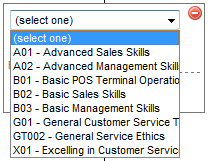
However in IE7 (even with the new <select> tag) it just truncates the values:

competency002a

When testing this with actual client data we realised they had values that differed in the last couple of characters only (e.g. "Training Course 001" and "Training Course 002"., but much longer).

So I went ahead and removed the width CSS property from the relevant class, and this is what we got:

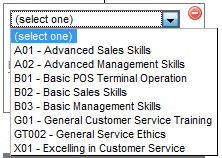
competency001

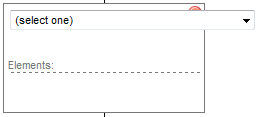
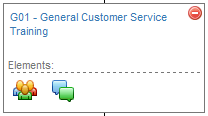
The problem is now that the remove icon is covered up, preventing the user from using it until they have selected something from the list and it replaces the edit box with the read-only one (like below):

competency005

I looked for ages to try and find good cross-browser safe ideas for how to handle this, and briefly tried using JavaScript to trap the onclick and onblur events and re-size the field at that point. Ugly. Buggy. And just plain nasty as a future-safe solution. I even tried setting width on <option> tags using CSS, but while that worked in Firefox it still failed in IE.

So after much trawling for help, and revising much of what I already knew about styling forms in CSS, I came across this gem of a solution. Setting the title attribute on the <option> tags allows them to show a tooltip in IE7 that shows the user the full text value of each option:

competency004

Monday, May 26, 2008

Om's got the wrong business model for Twitter

I've been spending a lot of time recently looking at product strategies for Elcom, so I was particularly intrigued by one of Om Malik's latest posts that highlighted a business model for Twitter in the midst of their Scoble Problem. He says that he has “a theory that could help Twitter solve its scaling conundrum and also help the company make money”. What he's referring to, of course, is the rather expensive impact that a popular user like Robert Scoble has on their infrastructure.

Twitter (see my feed in the right hand column of this blog) is self-described as essentially a messaging system built on an architecture that better suits a content management system. This means that every time someone tweets, a record is created in a database, and then subsequent to that, tens, hundreds or thousands of messages are sent regarding that tweet - potentially creating their own database records along the way. Unfortunately Scoble has 25,000 followers, so every post from him involves 25,000 messages (and possibly text messages to mobile phones).

“Of course, Om's answer is completely wrong.”

Om says that the answer for Twitter is to view commentators such as Scoble as cash cows, and charge them for the right to have a certain number of followers. Of course, Om's answer is completely wrong. Twitter needs Scoble much more than he needs them. Why should he pay to have followers there? There are dozens of startups waiting for someone like him to to give them the techies' equivalent of an Oprah moment.

Om is right in one sense, the answer to Twitter's business model is hidden in the Scoble example. Instead of charging Scoble for the right to use their system, they should charge people who want to follow Scoble - beyond perhaps the first hundred or so. This allows anyone to use Twitter (helping network externalities along), whilst ensuring that the really heavy loads on the system are paid for, but by the subscribers to the content producers, not the content producers themselves. Another problem is that anyone could create masses of bot accounts to simply drive up your least favorite twitterer's monthly bill.

“That's almost ten times the income without annoying Scoble”

Instead of charging Scoble $10/month for 1,000 subscribers, giving them $250/month, they could charge the people that want to follow Scoble (past the first 100 or so) 10¢/month each, giving them $2,490! That's almost ten times the income without annoying Scoble, by simply asking people to pay a small premium fee if they want to know what Scoble is thinking right now. With that model they can grow as much as they like, and encouraging people like Scoble to use Twitter becomes a win-win proposition.

They are left with a micro-payment problem, but if people follow more than one interesting twitterer then the payments will quickly add up, and with volume I'm sure you could make credit card companies your friends. Besides, you could probably inflate my 10¢/month to 50¢/month with no great outcry. Now Scoble might get annoyed if suddenly 20,000 of his followers disappear, but then again, at least he knows the other 5,000 place a real value upon his tweets - and that's worth a whole lot more in media terms.

[UPDATE: It seems Scoble's already gotten annoyed ...]

Tuesday, May 13, 2008

Digging into the sourcecode

One of the things that's really impressed me about the New Microsoft is that they're much more open about their sourcecode, especially the Visual Studio guys (who know their main customer base are all over issues like this).

It is even more impressive to see Scott Hanselman digging into their sourcecode for the latest VS2008 and .NET 3.5 SP1 Beta and using NDepend to show us how much has changed. In my books that absolutely rocks!

It actually makes me wonder whether this sort of analysis should form part of Elcom's sprint delivery procedures. In other words that we actually make the effort to stand back and analyse the sourcecode changes from 20,000 feet, rather than only looking at backlog items completed.

[UPDATE: Patrick Smacchia the NDepend lead developer (and C# MVP) takes the analysis one level deeper, again using NDepend.]

Friday, May 02, 2008

LinkedIn's cute outage page

This is a nice touch from LinkedIn, an outage page with attitude:

LinkedIn

Of course I would have preferred they not have an outage at all ...