
Showing posts with label SaaS. Show all posts

Wednesday, October 29, 2008

Salesforce.com's big bang Agile rollout

Whilst researching for next week's Scrum meetup in Sydney I came across interesting presentation by the Salesforce.com R&D guys as to how they transformed their internal development teams to Agile - all at one time.

Lachlan points out that the advantage of this approach is that it means there is no waterfall project running alongside the Agile ones and making them look bad (just because anything new will have its problems, and because Agile makes obvious existing dysfunctional behaviour).

Thursday, October 23, 2008

Tuesday, July 18, 2006

SaaS is letting me down

I'm getting pretty pissed off with my SaaS suppliers at the moment. In the main, that is GMail, Salesforce.com and Blogger. My main issues are twofold:

1. Slow performance
Dave Stephens recently gave his commentary on a recent Aberdeen report on Procurement SaaS. A key comment caught my eye because it resonated with my own experience:
“The only real negative I could find was in one statistic: 88% of respondents said that in house software system response time & performance was equal or better than SaaS. This reinforces my SaaS = renting-an-apartment analogy. At peak times some customers’ showers are running out of hot water! But it’s a solvable problem - the SaaS providers need to design their on-demand systems for peak load, not average load. And hopefully they will start doing that.”
Start. Doing. That. Well, yes, could they please get off their backsides and take care of this!?

[EDIT: Phil Jones rants more about Blogger on his Platform Wars blog. In the comments to his post, John from FreshBlog mentions the Blogger Hacks Wiki as a good place to find how others are 'hacking' Blogger. Heard about Phil from Dave Winer's Scripting News.]

GMail was wonderful when I first started using it, but in the last few months it has slowed to a crawl - even on a fast internet connection I find that simply labelling a post in my inbox takes 10-30 seconds. Salesforce.com has had some very public issues with its performance, which their main competitor, NetSuite, blames on their 'big iron' architecture. But the bigger issues for them are over-reliance on an old web interface paradigm, that in these heady days of AJAXified web apps seems a very inefficient way of forcing users to work with their data. Blogger has the least problems in this regard, because of its nice good UI design and their simple technical model (i.e. publishing your blog as static web pages to maximise cacheability and performance).

It's nice to know I'm not the only person getting annoyed at this.

2. Gluggy feature sets
“gluggy slow, sluggish - used to describe the operation of a computer”
Urban Dictionary
Blogger is the biggest culprit here. They've managed to add a handful of features to their blogging application in the last few years, and as a result now offer a far less satisyfing feature-set than many of their competitors. It is only thanks to the strength of the original design (pre-Google I might point out) and the great user-community, that people who want extra features (like categorisation) still hang around. The time must come soon though, when people start to move elsewhere, especially now that China, India, Pakistan and Ethiopia have taken to blocking access to blogger blogs.

Salesforce.com is bad in a different way, they have made me sluggish. Yes, AppExchange is a wonderful idea, but did we really need to get drowned with a thousand different applications? There is something to be said for having our choices restricted to a few truly great options, rather than the mess of good, bad and ugly that AppExchange really is. Once I wasted several hours looking at different applications, I realised that none of them would offer me anything I really needed or wanted on top of the basic Salesforce.com functionality (although I hear that one free one offers RSS feeds, that might be worth looking into). I could have better spent that time getting more use out of Salesforce.com's existing functionality rather than surfing the AppExchange Deadzone.

GMail has added some features, and steadfastly ignored others that users clamor for (like sorting by sender, or date, within a label or search view). The integration with Google Calendar is painful and half-baked. The fact is that my own use of it relies heavily on Greasemonkey, and so I find that using it from within IE (as I usually do outside of home) has become oddly stilted, as I reach for functions and options no longer available.

In Summary
I am a strong believer in the viability of the SaaS model. Removing maintenance headaches and installation gotchas are worth a lot, but the efficiences gained in being accessible anywhere and having economies of scale in the backend make it really appealing. I find myself agreeing with Jeff Kaplan on his identification of SaaS Myths, but in reality the applications on offer are still not fully ready for the enterprise. Many of them have not yet been tested on their performance, or security, or ability to keep up with technology changes. Market leaders like Salesforce.com, GMail and Blogger are showing signs of not handling things as well as they should, perhaps because the SaaS technical model is not yet fully mature, or simply because there is yet to be a realisation that they must handle peaks in demand, not just the average.

Technically speaking, SOA and advances in grid computing promise to deliver new levels of performance scalability, but applications must be built from the ground-up to full utilise these advantages. However, this sort of application programming can be pretty tricky (and yes, I know that threading <> grid computing, but it's got similar problems). However, there seems to be a recognition that this is an area of great opportunity, and some new vendors are planning to supply this next generation architecture.

From a security standpoint, enterprise IT departments have fundamental issues with hosting their data outside the corporate firewall. We have seen a recent rise in online storage providers, with ones like Amazon's S3 being aimed squarely at developers needing back-end data storage. Perhaps the next wave will provide data storage that is transparent to the SaaS application, but where hosting can either be outsourced or kept in-house. After all, SaaS providers usually have to promise not to access your data anyway, so why should they be bothered hosting it?

I think that the current depictions of SaaS 2.0 are missing the point if they think that better SLAs are all that is needed. Vital issues, such as performance, require both that the application be built differently from its very foundation upwards, and depend on the rollout of faster broadband access speeds across their marketplace.

For more on this subject see Dion Hinchcliffe's blog. But from my POV, the tipping point he's looking for ain't here yet.

del.icio.us tags:

Monday, March 13, 2006

NETaccounts: The MYOB killer?

On the way to a client this morning I came up with a great idea, a Web2.0 business application designed to kill off MYOB by providing SME owners with a basic accounting package that does 80% of what they need, a là Getting Real.

Well, hang on a second, it looks like NETaccounts has beat me to it with a nifty web-based accounting package. They have a good simple interface that also provides an easy way for SME owners to share their accounts with their bookeepers and accountants for a relatively low $295 per year (that's AUD, including 3 user logins). Even better, they have a published API on their developer network page that points out how to use web services to talk to their application.
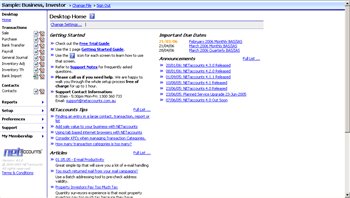
I've tried out their demo account, and it's a much nicer user interface than the confusing gray wasteland NetSuite throws at its users, but it still could learn a lot from Web2.0 applications like Gmail or Salesforce.com. They seem to be solving more than the 80% of problems that I would have targetted, but then they have been doing this since 2000. Their marketing could use a lot more money, but then again I found them within 30 seconds of googling for something like this, and they seem popular in the Mac community because they manage to bridge the Mac/Windows divide that separates many designers from their accountants.

From the look of it they are still actively developing the application, and seeing as they write in .Net I think we will continue to see them implementing new Web2.0 functionality (but RSS feeds will probably never be appropriate for this sort of app). Mashups with NETaccounts could be very cool, something with Salesforce.com could be useful for many organisations - the only worry is that NETaccounts may have too small a subscriber base to justify the effort involved. Their focus is on Australia at the moment, but there are some signs that they have considered expanding overseas, in which case having a Salesforce.com mashup would help them get exposure. Other mashups could include integrating POS/EFTPOS systems or even an online calendar like 30 boxes.

If they get their marketing act together and try to generate some buzz about their product then I could definitely see this givng MYOB a run for its money, especially with a slightly prettier user interface. If I had known about this product when I bought MYOB over a year ago then I would have reconsidered the decision and probably convinced my bookeeper that this was a better solution. A year after having bought MYOB I still haven't managed to get it setup and working right with my data file. This solution would have been an easy buy, especially as it would have impacted our cashflow less.

NETaccounts have a free 30-day trial in case you're interested.