This ought to be fun!

Find out more at the official site.
One of the things that's really impressed me about the New Microsoft is that they're much more open about their sourcecode, especially the Visual Studio guys (who know their main customer base are all over issues like this).
It is even more impressive to see Scott Hanselman digging into their sourcecode for the latest VS2008 and .NET 3.5 SP1 Beta and using NDepend to show us how much has changed. In my books that absolutely rocks!
It actually makes me wonder whether this sort of analysis should form part of Elcom's sprint delivery procedures. In other words that we actually make the effort to stand back and analyse the sourcecode changes from 20,000 feet, rather than only looking at backlog items completed.
[UPDATE: Patrick Smacchia the NDepend lead developer (and C# MVP) takes the analysis one level deeper, again using NDepend.]
This is annoying, I went to open an XPS document that someone at Microsoft kindly sent me in request to a query I had. A quick Google showed me that I should be able to open it with Vista's built-in XPS Viewer. However when I try to, I find it opens Mozilla Firefox with this message:
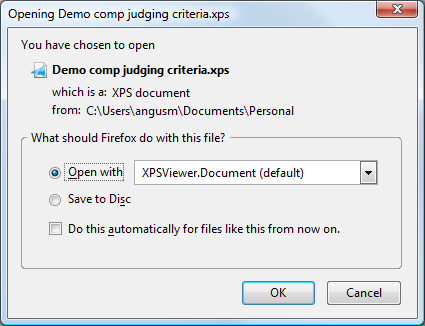
The only problem is that if I hit OK, it opens another tab in Firefox with the same popup, ad infinitum.
Making IE my default browser solved the problem, but if the darn things is dependent upon IE then it should just try opening in it in IE, regardless of what my default browser is, grrrr ... I checked for a Firefox add-in, but couldn't find one, so I ended up making IE my default browser for the 2 minutes it took to open and print the document.
In case you're interested I develop cross-browser apps so I need multiple browsers on my PC, and I prefer to use Firefox for random links I open because of the excellent NoScript add-in, which prevents my PC getting reamed by dodgy code on the websites I visit (which can sometimes happen on even the most reputable sites).
There are some great photos from CCOz on Flickr. I even managed to find one on Mitch's blog that showed me ... I'm the bloke slouching inside the big yellow ellipse (thanks to the Expression Design eval I picked up).
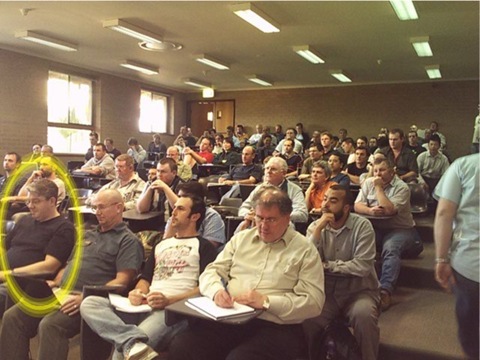
It has been great meeting so many friendly and helpful people and Twitter has had some very lively threads on it. If you want to check out what is happening realtime (or afterwards), look for the ccoz tag on Hashtags.
Jeff Wharton challenged me to do a presentation myself, I guess because of my smart aleck comments from the peanut gallery. I'd like to do one on XML literals in VB9 having just spent the last month working on our branching pathways diagram code for Elcom's Learning Management System and being up to my elbows in it (and Prototype).
I'm really enjoying being here. We've had some great sessions from favourites like Greg Low (SQL Server 2008 and how to present at events) and new guys like Shane Morris (User eXperience). Right now Paul Stovell is giving me a headache trying to keep up with his Reactive Programming via SyncLINQ.
It's also been great discussing things with guys from Readify, SSW, and the tons of other companies represented here, I even met the AFP alumni from Canberra.
Coming out of this I am sure that Craig and I will be raving about Windows Server 2008 Hypervisor and looking for greater use of VMs internally (as well as SQL clusters) and pushing for more emphasis on UX in the dev team at Elcom, which should make Anthony happy!
Next up, TDD of DotNetNuke Modules by Philip Beadle ... very relevant to us.

I'm all set to go to Code Camp Oz 2008 but I'm wondering who else I'll know there. Craig Bailey and I will be sharing a car to/from the event (we're both staying in Wagga Wagga city centre).
Personally I'm most looking forward to Greg Low's workshop on presenting at events, Philip Beadle's TDD 'in the trenches' session and Luke Drumm's swashbuckling DLR session. It will also be interesting to grill the MVP's that come to Code Camp Oz on the back of the MVP Global Summit in Seattle.
Finally, what is it with the Code Camp Oz logo? I'm going to have to see if I can carve out a spare couple of hours to improve upon it ...
“The main theme of the presentation is the same one I've been talking about on and off over the past year or two: moving Visual Basic back towards it's scripting roots. The main thrust of this presentation was the technical side of the story--namely, what we would need to do to the existing Visual Basic compiler to be able to effectively use it as a scripting engine. The presentation talks some about the way the compiler is structured, how it might change and some of the things were thinking about enabling.He also pointed out that language changes (like the XML native stuff in VB9) are necessary too:“all the services that the compiler provides...are available to be used by any program that needs them.”In particular, what we'd like to see is not just that Visual Basic can be embedded anywhere, but that all the services that the compiler provides--parsing, semantic analysis, code generation--are available to be used by any program that needs them. The DLR is a key part of this, but there's a lot of work on top of that.”
“One thing this presentation didn't cover (and which Ted Neward brought up in the Q&A afterward) is what we might do to the language itself to make it more scripting-friendly. That's an area where things are less well-defined and even more speculative than what I talked about, so I left it out for now.”Making the IDE services available to other programs allows a suite of competitors to Visual Studio to open up - so I'm not sure whether that will really fly (unless it's protected by licensing). But it does offer intriguing possibilities for scripting tools for administrators to use (provided they are familiar with VB) and perhaps even the ability to give end-users some access to create code in a Domain Specific Language (DSL) that makes sense to them. It could let you create an online query tool for large XML files. Whether modern systems administrators will welcome this sort functionality is another thing of course - and the security implications could be pretty scary.
“Computer languages influence how you think about a problem, and how you think about communicating ... Designing a solution with Lisp in mind will produce different results than a solution based on C-style thinking, and vice versa. Conversely, and we think more importantly, the language of the problem domain may also suggest a programming solution.”
“The alt.net mind-set is one that is very familiar to me. It has that mix of agile + object-orientation + patterns + TDD + DDD which is very much the school of software development that I favor. (Lacking a proper name for it, I'm inclined to call it the OOPSLA school of software development.) There is certainly a belief that there is a mainstream Microsoft orthodoxy at the moment, one that doesn't fit the OOSPLA school. And there's some frustration with that. But the point here is that it's not that the alt.net community thinks that the perceived mainstream Microsoft route should be erased, but that the Microsoft world is big enough for different approaches.”To all this I say a big hooray! But ... it seems everyone who wants to do something with ALT.NET is a devoted fan of C# (or at least NOT a fan of VB). So every code sample, explanation or tool is aimed at C# and either requires much grokking to be used in VB, or in many cases, cannot be used with VB at all.

“ASP.NET MVC: This model view controller (MVC) framework for ASP.NET provides a structured model that enables a clear separation of concerns within web applications, and makes it easier to unit test your code and support a TDD workflow. It also helps provide more control over the URLs you publish in your applications, and more control over the HTML that is emitted from them.”I think this finally gives ASP.NET developers some much needed flexibility. The guys at Microsoft are taking pains to point out this is not a replacement for the existing WebForms model, but they point to the following reasons to use the new framework:

