“The sad reality is that never before has an enemy hidden in such plain sight. Osama bin Laden declared a jihad against America in 1998. Iran's nuclear president vows to wipe Israel off the map. A year before the tube bombings, radical Brit imam Omar Bakri announced that a group of London Islamists are "ready to launch a big operation" on British soil. "We don't make a distinction between civilians and non-civilians, innocents and non-innocents," he added, clarifying the ground rules. "Only between Muslims and unbelievers. And the life of an unbeliever has no value."But on a more visceral level, it sounds like the movie United 93 will help make the point real to the average cynical Aussie punter. Seeing it on the movie screen, and hearign that it is based on the real events of that day, will make far greater impact than a bunch of academics standing up and declaring themselves id10ts.
Our enemies hang their shingles on Main Street, and a University of Western Ontario professor puts it down to a carefully planned substitution of transponder codes.”
Monday, September 18, 2006
Conspiracy theories go 'pop'!
The conspiro-nutters need a little deflating and Canadian Mark Steyn is happy to oblige.


Sunday, September 17, 2006
Re-Design Complete
Well, the re-design of the blog into Blogger Beta is 99% complete. There are some minor tweaks still to go, but nothing functionally weird. There are some new features, namely the built-in tags (finally!), the RSS feed for comments and the much more functional archive browse feature. However, the graphical element was the most fun part of it. There are now three columns, some prettier colours and a nice logo.
Let me know if you come across any particularly egregious bugs ... or don't ... because if I don't know about them, I won't worry about them!
“A common mistake that people make when trying to design something completely foolproof is to underestimate the ingenuity of complete fools.”
Douglas Adams
Let me know if you come across any particularly egregious bugs ... or don't ... because if I don't know about them, I won't worry about them!
Two Kinds of Geniuses
Wired asks us What Kind of Genius Are You? David Galenson's answer gives all of us 'late bloomers' some hope of impending attacks of genius:
I've talked about this a LOT recently with various friends and business associates. It doesn't seem far fetched as an idea, in fact it seems almost commonsense - yet I suspect that there is a subtlety to Galenson's idea that commonsense misses. The early geniuses are actually not that successful later in life - it is not just that their early success is what is most well-known. Galenson actually considered cold, hard cash value of their works.
Story via Jeff Putz.
“What he has found is that genius – whether in art or architecture or even business – is not the sole province of 17-year-old Picassos and 22-year-old Andreessens. Instead, it comes in two very different forms, embodied by two very different types of people. “Conceptual innovators,” as Galenson calls them, make bold, dramatic leaps in their disciplines. They do their breakthrough work when they are young. Think Edvard Munch, Herman Melville, and Orson Welles. They make the rest of us feel like also-rans. Then there’s a second character type, someone who’s just as significant but trudging by comparison. Galenson calls this group “experimental innovators.” Geniuses like Auguste Rodin, Mark Twain, and Alfred Hitchcock proceed by a lifetime of trial and error and thus do their important work much later in their careers. Galenson maintains that this duality – conceptualists are from Mars, experimentalists are from Venus – is the core of the creative process. And it applies to virtually every field of intellectual endeavor, from painters and poets to economists.”(emphasis mine)
I've talked about this a LOT recently with various friends and business associates. It doesn't seem far fetched as an idea, in fact it seems almost commonsense - yet I suspect that there is a subtlety to Galenson's idea that commonsense misses. The early geniuses are actually not that successful later in life - it is not just that their early success is what is most well-known. Galenson actually considered cold, hard cash value of their works.
Story via Jeff Putz.
V for Vendetta
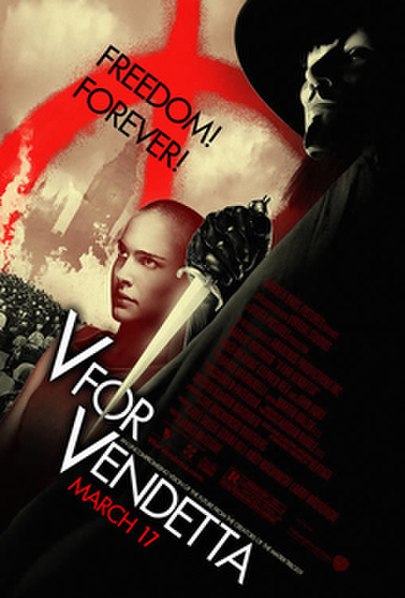 Top of the head rating: 4/5
We watched the wonderful V for Vendetta last night. It was a great film, with enough going on to keep us rivetted to it, despite the Phantom of the Opera overtones of an masked hero living in the underground.
It was nice to see a film that treated it's audience as intelligent people, that did not over-explain, or at the other extreme oversalts with handwaved plot points or coincidences. There are, of course, some unexpected issues. V appears to be wealthy, but no reason is given for that (except perhaps theft), he is exceptionally gifted in combat (again no reason), and at the end seems to have some Matrix-like speed (a Wachowski brothers movie of course ...). V is entitled to be mysterious, because he is the center of the plot, the epitome of the mystery being unravelled. It seems fitting that as he says he does not believe in coincidence, he is surrounded by them. Also, we come into the story well at the end - you eventually realise that this is the culmination of over a decade's hard work.
The actors do a fine job within the weirdness of this future vision. Hugo Weaving's voice beautifully conveys emotion even when his face is unseen, and Natalie Portman is believable as a bystander pulled into the plot - although her British accent is atrocious in the first few scenes (I was sure she was meant to be playing a Yank stuck in Britain). The rest of the cast play their parts well, although only Stephen Rea is really stretched by his role. Roger Allam deserves special mention for his too-brief egotistical ravings as the "Voice of London". In fact the words of the screenplay are beautifully selected, and add the texture to the monochromatic fascist background of dystopian Britain. For example, this piece by V shows a nice self-mocking turn of phrase:
“Voilà! In view, a humble vaudevillian veteran, cast vicariously as both victim and villain by the vicissitudes of fate. This visage, no mere veneer of vanity, is a vestige of the vox populi, now vacant, vanished. However, this valorous visitation of a bygone vexation stands vivified, and has vowed to vanquish these venal and virulent vermin vanguarding vice and vouchsafing the violently vicious and voracious violation of volition. The only verdict is vengeance; a vendetta held as a votive, not in vain, for the value and veracity of such shall one day vindicate the vigilant and the virtuous. Verily, this vichyssoise of verbiage veers most verbose, so let me simply add that it's my very good honor to meet you and you may call me V.”So is it perfect? Frankly no, it took a third of the movie for me to realise that "St Mary's" is the name of the disease central to the plot, and not just a location. Most of the characters seem a bit too cardboard cutout, and in a fascist state, men with guns rarely hesitate to shoot mobs of rebels - even if unarmed.
it is however well worth seeing, and whilst some people have identified modern American neo-conservatives with the Norsefire fascists in the film, I think that a more certain view is that government is intended to be for the people, and any government that forgets that is on the slippery slope to fascism.
Friday, September 15, 2006
Extreme Changes Ahead!
I will be changing my blog from the old standard blogger templates to the new beta layout this weekend. Expect to find some weird stuff appearing, disappearing and possibly bugs floating around. Along the way I will move from using my del.icio.us account to tag posts, to using the new labelling system. This will be the second blog I've extensively modified using the new beta layouts, so all should go well.
Citizen vs Tribesman
America's ABC has an interesting article on Why We Will Never See Democracy in the Middle East. Steven Pressfield says the key is the longstanding conflict between the mindset of 'citizen' and 'tribesman'.
I think that there is clear example of citizens winning this war once before ... Australia's ABC aired an interesting documentary last night called Carthage: The Roman Holocaust that looked at how Carthage was copied, and eventually surpassed, by Rome. The point made was that Rome took the advanced culture, agriculture and trading routes of the Carthaginians and added an extra element - the cult of the Republic. Suddenly people who were once Roman enemies, came to see themselves as Roman citizens, and part of what their ancestors once fought. Historian Richard Miles points to the baths, the theatre and the temple as the tools Rome used to bind newly conquered peoples to the idea of citizenship.
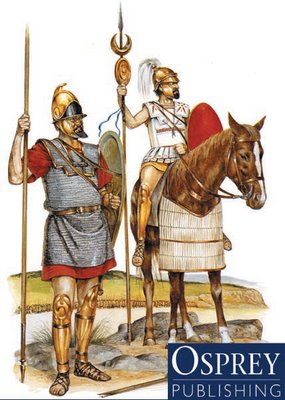
Carthaginian Veterans
Is there a lesson in this for our conflict with the tribesmen of the Middle East, or closer to home, the Solomon Islands?
via Chaos Manor's RSS feed
“What exactly is the tribal mind-set? It derives from that most ancient of social organizations, whose virtues are obedience, fidelity, warrior pride, respect for ancestors, hostility to outsiders and willingness to lay down one's life for the cause/faith/group. The tribe's ideal leader is closer to Tony Soprano than to FDR and its social mores are more like those of Geronimo's Apaches than the city council of Scarsdale or Shepherd's Bush.”He makes a particular point about how the citizen takes part in war, but the tribesman takes revenge:
“The tribesman does not operate by a body of civil law but by a code of honor. If he receives a wrong, he does not seek redress. He wants revenge. The taking of revenge is a virtue in tribal eyes, called badal in the Pathan code of nangwali. A man who does not take revenge is not a man. Al Qaeda, Hezbollah, and the sectarian militias of Iraq are not in the war business, they are in the revenge business. The revenge-seeker cannot be negotiated with because his intent is bound up with honor. It is an absolute.”If true, then that places the War on Terrorism not within the religious grounds of Christianity vs Islam, nor within the political arena of Democracy vs Theocracy, but on the more philosophical grounds of State vs Tribe - or from the terrorists' view, of personal revenge.
I think that there is clear example of citizens winning this war once before ... Australia's ABC aired an interesting documentary last night called Carthage: The Roman Holocaust that looked at how Carthage was copied, and eventually surpassed, by Rome. The point made was that Rome took the advanced culture, agriculture and trading routes of the Carthaginians and added an extra element - the cult of the Republic. Suddenly people who were once Roman enemies, came to see themselves as Roman citizens, and part of what their ancestors once fought. Historian Richard Miles points to the baths, the theatre and the temple as the tools Rome used to bind newly conquered peoples to the idea of citizenship.
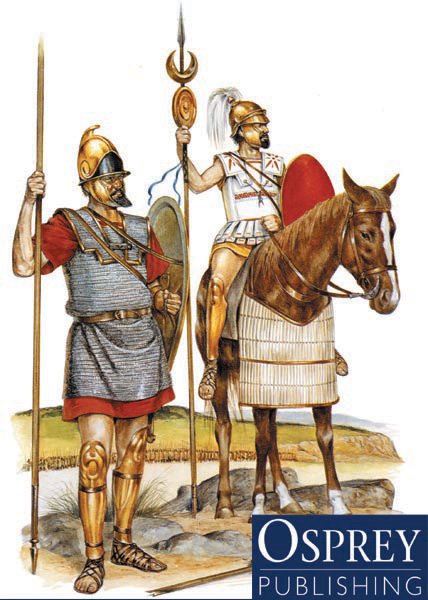
Is there a lesson in this for our conflict with the tribesmen of the Middle East, or closer to home, the Solomon Islands?
via Chaos Manor's RSS feed
Monday, September 04, 2006
Do Web 2.0 thingies increase sales?
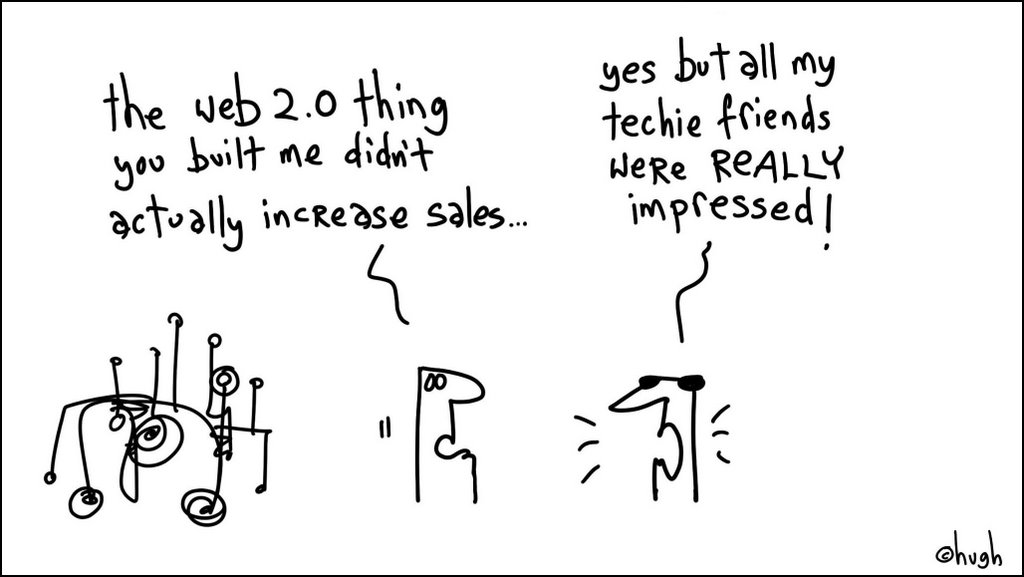
“the web 2.0 thing you built me didn't actually increase sales...”
Care of Hugh.
Scoble's not sure that they do (yet). I'm pretty sure that it might be the latest fashion to have a Web 2.0 front-end (and good design), but it certainly does NOT guarantee sales.
Subscribe to:
Posts (Atom)